Deep dive: Eli Lilly & Novo Nordisk
30 April 2026
In the last two years, Silicon Valley has sucked all the oxygen out of the room. But while the world was looking at chips, a different kind of engineering was quietly rewriting the future of global health. We are witnessing the “GLP-1 Era,” where Eli Lilly and Novo Nordisk are fighting for the pole position in a market projected to be about $300 billion by 2030.
The Titans and Their Arsenals
At the center of this storm are two specific compounds. Novo Nordisk leads with Semaglutide (marketed as Wegovy for weight loss and Ozempic for diabetes). Eli Lilly counters with Tirzepatide (Zepbound for weight loss, Mounjaro for diabetes). These drugs mimic hormones that tell your brain you’re full, but they are more than just “diet pills”—they are metabolic re-engineers.
About the Companies
Novo Nordisk: A Danish giant born from a 1920s Nobel Prize-winning discovery. It was originally two competing companies (Novo and Nordisk) that merged in 1989. For a century, they have been the undisputed “Kings of Diabetes,” focusing almost exclusively on chronic metabolic diseases.
Eli Lilly: An American powerhouse founded in 1876 by Colonel Eli Lilly. They were the first to mass-produce insulin in the 1920s and later gave the world Prozac. While they are more diversified than Novo, their expertise in diabetes is what led them to this moment.
The Brutal Math of R&D
Before a drug ever reaches a patient, it must survive a “gauntlet of failure.” Pharmaceutical companies spend billions in R&D, but the success rate is sobering.
The Bottom Line: Out of thousands of compounds discovered, only a handful make it to the mass market. This high failure rate is why “winners” like GLP-1s carry such astronomical price tags; they have to pay for all the failures that came before them.
The Patent Shield: A Ticking Clock
Once a medicine is finalized, companies file for Patents. A patent typically lasts 20 years from the date of filing, but remember: the clock starts during Discovery. By the time the drug is approved, the company may only have 10 to 12 years left of exclusivity.
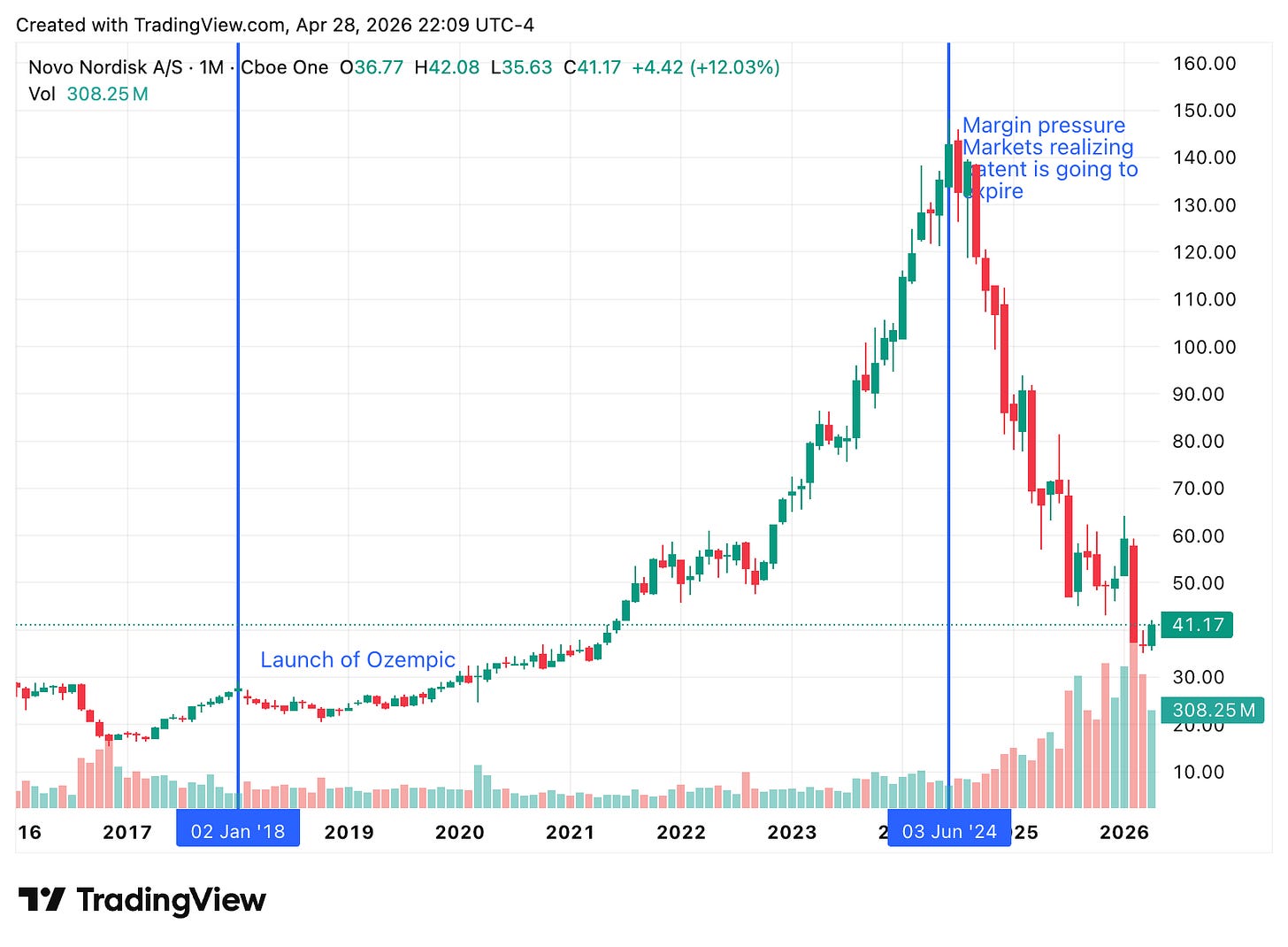
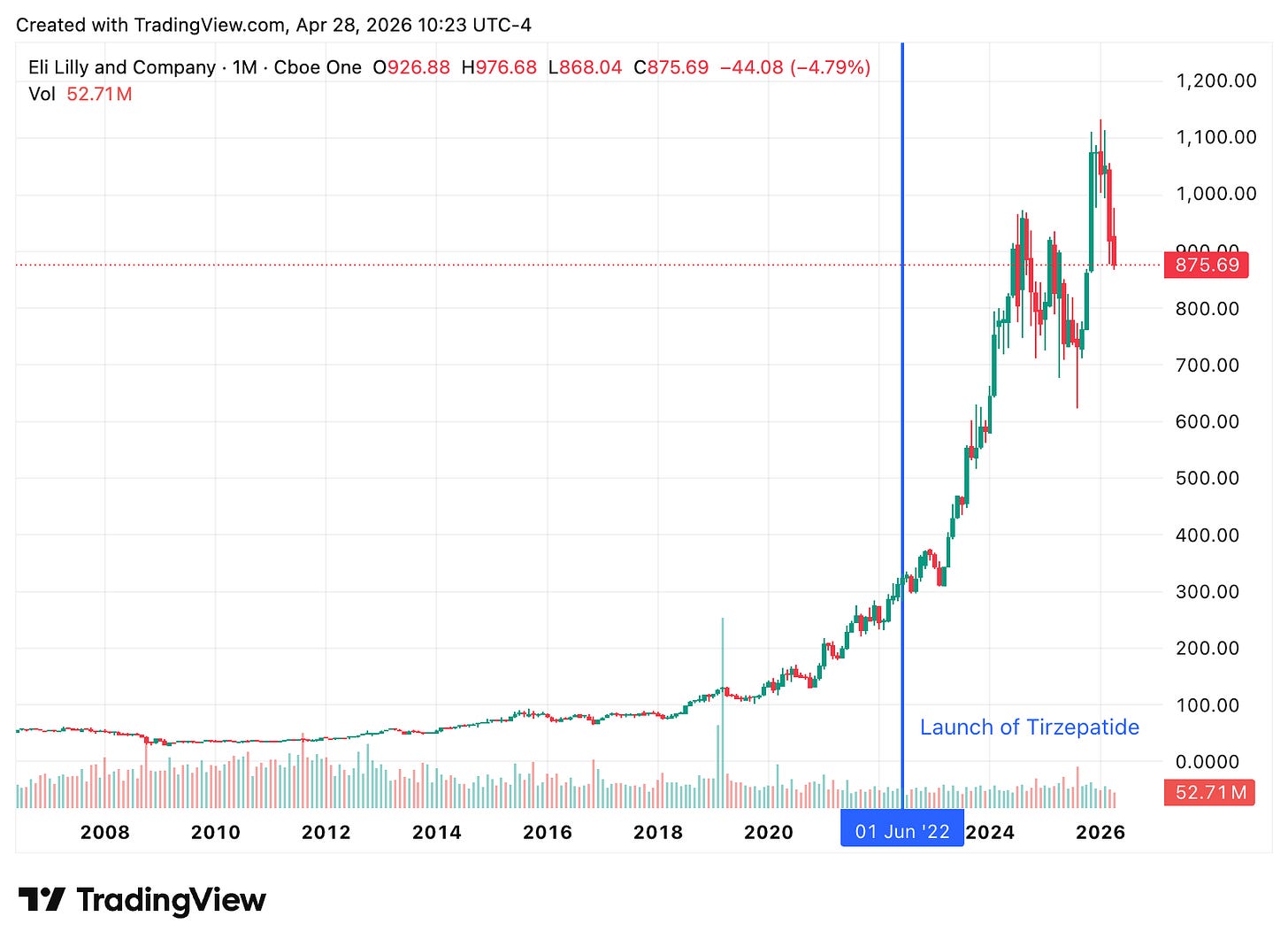
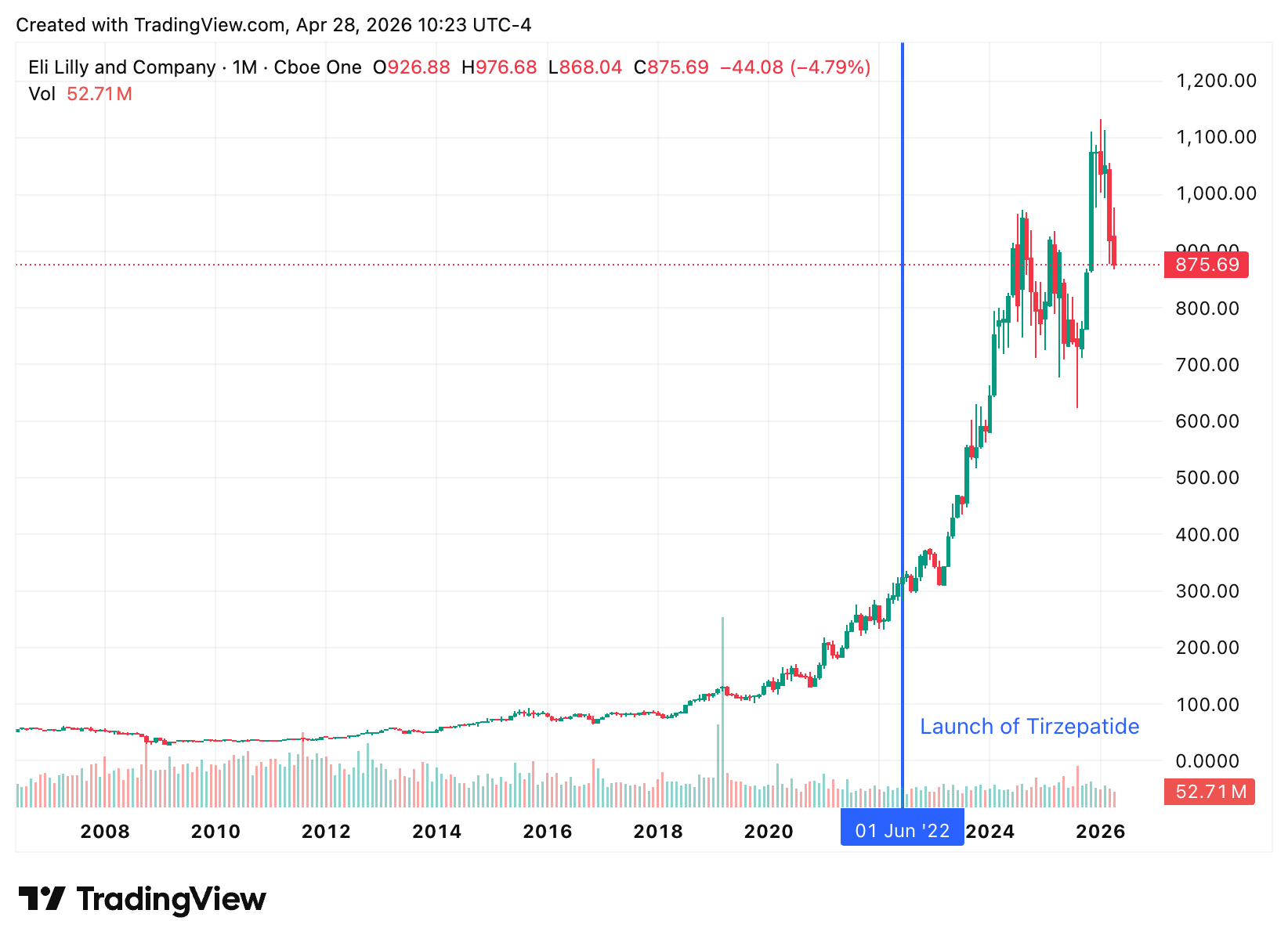
Novo Nordisk (Semaglutide): Core patents are already beginning to expire in markets like China and India (2026). In the US, the “cliff” is currently projected for 2031–2032. The following chart shows how the stock price went up when the drugs were launched and how the stock corrected when the patents expired in certain countries
Created with TradingView Eli Lilly (Tirzepatide): Being a newer entrant, its runway is longer, likely extending to 2036.
Created with TradingView
Post-R&D: The “Last Mile” Challenges
Success isn’t just about the science. After the patent is secured, companies face:
Supply Chain: GLP-1s require specialized “cold chain” storage and complex injection pens.
Prescription Barriers: Convincing doctors and insurance companies to cover a $1,000/month drug is a relentless marketing battle.
The “Evergreening” Game: How They Hold On
Big Pharma doesn’t just let a patent die. They use “Evergreening” to exploit the system:
Product Hopping: Moving patients from a weekly injection to a daily pill (oral versions) just as the injection patent expires.
The Patent Thicket: Patenting the chemical salt, the specific dosage, and even the “click” mechanism of the injection pen to block generics.
The Pfizer Parallel: A Warning to Investors
In my previous deep dive on Pfizer, we analyzed how a single, world-changing product—the COVID-19 vaccine—sent valuations into the stratosphere. At its peak, Pfizer felt invincible. But as I noted then, when sales dropped and the “miracle” normalized, the gravity of the market was unforgiving.
Lilly and Novo are currently in their “Vaccine Moment.” Their stock charts are vertical lines, but they are sprinting against a clock that most retail investors don’t understand: The Patent Life Cycle.
One might argue this is different; obesity is chronic, whereas a pandemic is a moment in time. However, the result is the same: Democratization. Why the “Generic Era” Wins for Society
When other companies eventually “exploit” the patent or find workarounds, the margins drop from 90% to 10%, making the drug usable for the mass market.
The Lipitor Lesson: When the cholesterol drug Lipitor (the best-selling drug of all time) lost patent protection, the price plummeted from $5 a pill to cents. This was a “loss” for Pfizer shareholders, but a massive victory for global public health. Millions more people could suddenly afford life-saving care.
Bottom Line: The “Fair Price” Rule
Be it AI or weight loss, retail investors shouldn’t run behind the fad. These are incredible scientific achievements, but a great company is a bad investment if you pay too high a price for its “peak.”
Wait for the “AI fog” and the “GLP-1 cyclone” to clear. Look for the fair price. Because in the end, every monopoly has an expiration date.
Some useful links
The coming Ozempic patent cliff - This video provides a timely breakdown of how the patent expiration for semaglutide is already impacting major markets like Canada and India in 2026.
Disclaimer: I am not a financial or investment advisor. The information provided in this article is for educational and informational purposes only. Investing involves risk, and past performance is not indicative of future results. It is best to consult with a certified financial professional before deploying capital into any investment.