Beyond the Market
22 April 2026
Ever wonder who actually owns the hospital down the street, the software you use at work, or your favorite sandwich shop? Chances are, it’s a group of people you’ve never met.
What is Private Equity? (The “Fix-and-Flip” Club)
Imagine you and a group of friends pool your savings to buy a run-down house. You aren’t buying it to live in; you’re buying it to fix it up, increase its value, and sell it for a profit a few years later.
Private Equity (PE) is exactly that, but on a massive scale. Instead of houses, these firms buy entire companies. They take these companies “private” (meaning you can’t buy their stock on a regular exchange anymore), spend a few years trying to make them more profitable, and then sell them.
How PE Buys a Company: The “Mortgage” Strategy
Most people think PE firms buy companies with 100% cash. They don’t. They use a strategy called a Leveraged Buyout (LBO).
Think of it like this:
The Down Payment: The PE firm uses a small amount of cash collected from their investors (about 30%).
The Mortgage: They borrow the remaining 70% from a bank.
The catch: The PE firm doesn’t pay back that mortgage—the company they just bought does. The company has to use its daily profits to pay off the massive loan the PE firm took out to buy it. If they grow the company’s value, that “leverage” (the loan) makes the final profit for the investors much, much bigger.
How is this different from a Mutual Fund?
If you own a Mutual Fund (like a 401k or an Index Fund), you are a passive passenger. You own a tiny slice of 500 companies, and you can sell your shares whenever you want.
In Private Equity, the firm is the active driver. They sit on the Board of Directors, they fire the CEO if they want, and they decide exactly how the business is run. However, once you put your money in, it is “locked.” You usually cannot get your cash back for 7 to 10 years.
The Giants: Who are the Big Players?
These three firms are the “Kings of Capital.” They manage a staggering amount of wealth across many sectors (like Real Estate and Insurance), but their Private Equity divisions specifically focus on buying and fixing companies.
Why Companies Choose PE Over the Stock Market
Why would a company choose to be owned by a Private Equity firm instead of listing itself on the stock market (IPO)? For many CEOs, the stock market has become a “glass house” that is too difficult to live in.
Escaping the “90-Day Trap”: Public companies are forced to report profits every 3 months. If they have one bad quarter, their stock price crashes. In Private Equity, they can focus on a 5-year plan without having to explain every minor setback to thousands of shouting public shareholders.
Privacy for “Gut Renovations”: Fixing a broken company is messy. It involves cutting costs, changing management, and making painful pivots. PE allows a company to do this “in the dark,” away from competitors who would otherwise see their every move in public financial filings.
Why Big Investors Choose PE Over Public Stocks
If you are a High-Net-Worth Individual (HNI) or a giant Pension Fund, you are looking for two things that the regular stock market often struggles to provide:
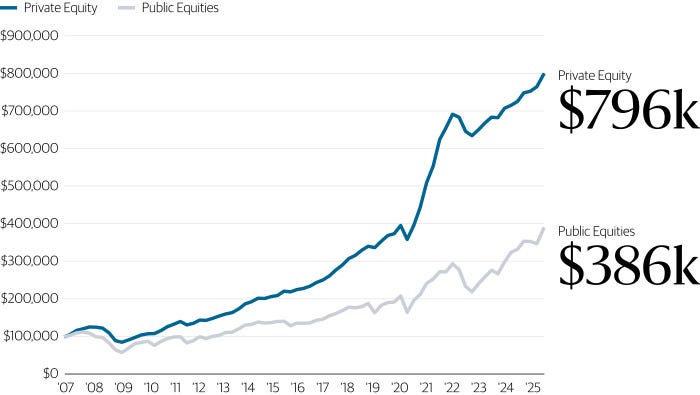
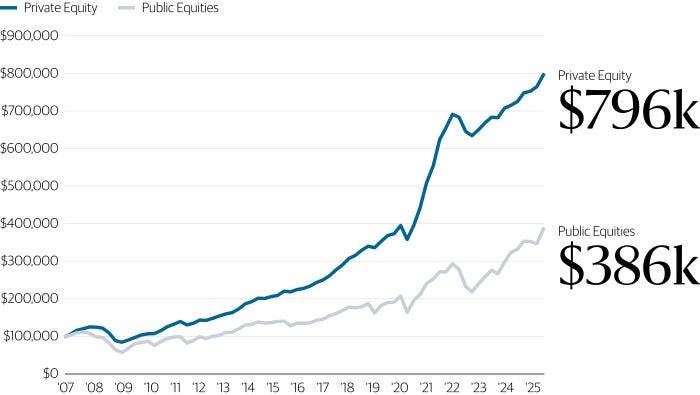
The Hunt for “Alpha” (Higher Returns): The stock market typically returns 7-10% per year. Large investors are hunting for much more. They hope that by locking their money away, the PE firm’s aggressive “Fix-and-Flip” strategy will turn that 10% into 15% or 20%.. The below graph shows the performace of PE funds over public equity funds handled by blackstones (source).
Lower Volatility (on paper): Stock market prices swing wildly every day based on news headlines. Private Equity values only change a few times a year. For a Pension Fund, this makes their balance sheets look “smoother” and less stressful, even if the underlying risks are high.
The Current Crisis: The “Interest Rate Trap”
This system worked perfectly when interest rates were near zero. But now, the world has changed, and the “Mortgage Strategy” we mentioned in Section 2 is backfiring.
The Problem:
Imagine you bought a business and took out a huge loan with a 3% interest rate. Suddenly, that rate jumps to 8%.
Reduced Profits: The company you bought now has to send almost all its cash to the bank to pay the higher interest. According to the Financial Times, these borrowing costs have surged significantly in 2026.
The Squeeze: Because the company is spending all its money on interest, it has less money to hire people or grow.
The Reality Check: Even though these giant firms are moving record amounts of money, the fine print tells a different story. In their latest reports, Lazard and Jefferies show that when investors need cash and sell their stakes early, they are often forced to take a “haircut.” Even in a “strong” market, they are typically selling their investments for 8% to 15% less than what they claim they are worth on paper.
Why Should You Care? (The “Invisible” Connection)
You might think, “I’m not a millionaire, so this doesn’t affect me.” Actually, it does.
Private Equity firms get their money from Institutional Investors. This is a fancy word for Pension Funds, Teacher Retirement Funds, and Insurance companies. If you have a pension or a retirement account through work, your money is likely being handed over to these firms. As highlighted by financial experts on Be Rich, if these markets “choke,” it can impact the entire global credit cycle.
💡 Pro-Tip: Take a look at your pension fund or 401(k) statement. Check the “Alternative Investments” or “Private Markets” section. It is important to make sure the amount invested in these high-risk PE deals actually suits your personal risk appetite.
The New Architect of our World
Private Equity is the invisible architect of the modern economy. From the office where you work to the grocery store where you shop, these firms are making the decisions that shape our world.
While the “Fix-and-Flip” strategy has created immense wealth, the current era of high interest rates has changed the rules. As an average person, you aren’t just a bystander—you are often the ultimate financier of these deals through your retirement savings. By understanding how the “Invisible Owner” operates, you move from being a passive observer to an informed participant in your own financial future.
Plain English Glossary
AUM (Assets Under Management): The total value of all the “stuff” (companies, buildings, land) a firm currently looks after.
The Exit: When a PE firm finally sells a company. This is the “payday.”
Leverage: A fancy word for using borrowed money (debt) to try and make more profit.
Disclaimer
I am not a financial advisor. This article is for educational purposes only. Private Equity is a complex and high-risk field. Your retirement savings are your future—always conduct your own research and speak with a certified financial professional before making big investment decisions.